
The Layers of the AI Stack
At Hollow Brook, we share many of the concerns investors have about the current artificial intelligence (AI) landscape. It remains unclear whether the massive capital expenditures across the AI ecosystem will ultimately generate returns sufficient to justify the investment. We are also mindful of the increasingly interconnected nature of AI financing, in which capital, infrastructure spending, and valuations reinforce one another and potentially amplify any disruption along the chain. While AI is likely to prove transformative, transformative technologies do not necessarily produce attractive investment returns at every valuation. History offers several examples of groundbreaking innovations that were accompanied by periods of excessive optimism, investment booms, and subsequent busts. The late 1990s telecom and internet buildout is a notable example: the technology developed ultimately transformed the global economy, but many of the long-term benefits emerged only after a significant market correction. Today, some leading frontier AI companies, particularly private firms such as Anthropic, appear to be valued on highly optimistic assumptions about future growth and profitability. At the same time, aggregate corporate earnings remain strong, and many large AI investments are being funded by companies with substantial cash flow, healthy balance sheets, and established business models.
Rather than trying to predict which frontier models or AI platforms will emerge as long-term winners, we believe a more prudent approach is to focus on areas where the economics are more observable. These include the infrastructure that enables AI, the ecosystems supporting its buildout, and high-quality businesses that are already generating attractive returns and can use AI to improve efficiency, strengthen competitive advantages, deepen customer relationships, or expand their addressable markets.
This approach is designed to help clients participate in the long-term benefits of AI adoption while managing the risk of paying for outcomes that fall short of optimistic expectations. We remain constructive on AI’s potential, disciplined on valuation and selective in implementation. This philosophy has long guided our investment process and remains central to how we allocate capital.
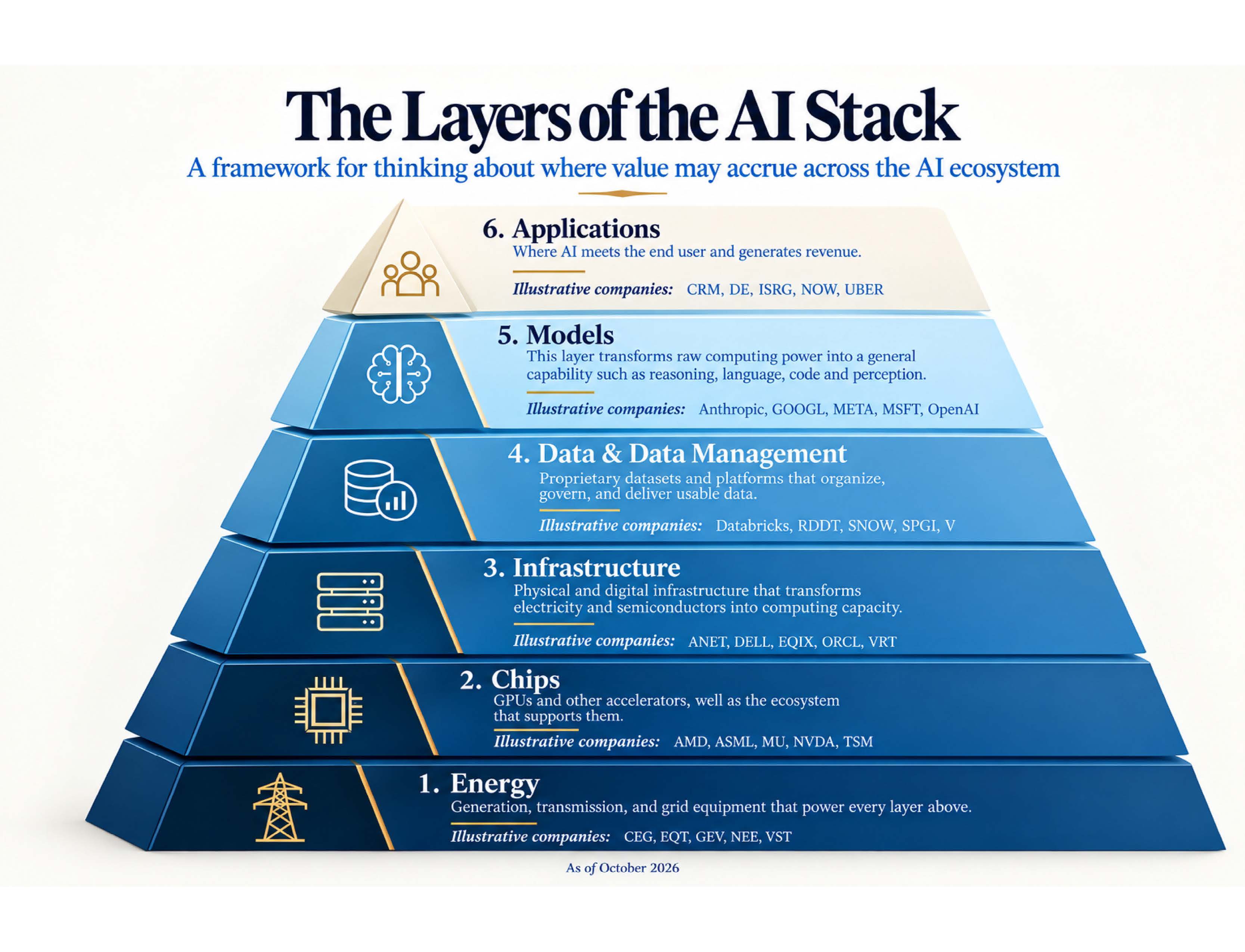
When constructing and managing portfolios, we think about the AI stack in terms of the following six layers:
 6. Applications
Top LayerWhere AI meets an end user and generates revenue: copilots, agents, ad optimization, drug discovery, autonomous driving, and customer service, whether sold as software or embedded in an existing business.
Contribution: This is where the economic value ultimately must emerge to justify the investment in every layer below. NVIDIA’s CEO Jensen Huang's flywheel argument states every successful application pulls demand through the lower layers, back to the power plant.1
Adoption data to date indicates this layer remains early in its development. Only about one in five U.S. businesses report using AI in any business function,3 56% of CEOs say AI has not yet delivered significant financial benefits,4 and just 2–3% of U.S. households pay for an AI subscription.2,5 This layer therefore offers both the longest runway and the greatest uncertainty.
Think multi-tiered for this layer: productivity software, consumer platforms, & physical AI.
Illustrative companies: ADBE, AMZN, CRM, CRWD, DE, GOOGL, ISRG, MSFT, NFLX, NOW, PANW, PLTR, SPOT, TSLA, UBER, ZS
5. Models
The intelligence itself — frontier closed models (e.g. ChatGPT, Claude, Gemini, Grok), open-weight models (e.g. DeepSeek, Kimi, Llama, Qwen), and the labs that build and train them.
This layer transforms raw computing power into a general capabilities such as reasoning, language, code, and perception.
Contribution: The model layer is where the technology has become sufficiently capable to support practical use cases. Advances in reasoning, reliability, and ease of use pushed AI beyond experimentation and into real-world deployment, driving demand across the broader ecosystem. Yet, despite serving as the catalyst for the AI boom, the model layer may not be the easiest place for investors to capture value. Several frontier labs remain private, competition is intense, and open-weight models are rapidly narrowing capability gaps. These dynamics could compress pricing power and margins, causing a larger share of industry profits to accrue to other layers of the stack.
Illustrative companies: Anthropic, BABA, BIDU, GOOGL, META, MSFT, OpenAI
4. Data and Data Management
The proprietary datasets from which models learn and on which applications act, together with the platforms that organize, govern, and deliver that data. This layer comprises two distinct businesses: data owners, which hold unique, hard-to-replicate datasets such as transaction flows, user-generated content, credit histories, viewing behavior; and data management platforms, which make enterprise data clean, governed, and usable by the layers above.
Contribution: As models and computing power become more accessible, proprietary data may become the most durable source of differentiation in the AI stack. Unlike computing power, which can be purchased, or models, which can be replicated, unique datasets often reflect years of accumulated history, context, and domain-specific knowledge that cannot easily be recreated. Companies that control these assets can leverage advances in the layers below while maintaining a defensible competitive advantage. Reddit's licensing agreements with leading AI labs illustrate how valuable exclusive and continuously refreshed data can become.
Data management platforms, meanwhile, benefit from the broader AI adoption by earning revenue from the growing volume of data being prepared and organized, regardless of which model or application ultimately succeeds.
Illustrative companies: Databricks, MA, MSCI, RDDT, SPGI, V, SNOW
3. Infrastructure
The physical and digital infrastructure that transforms electricity and semiconductors into usable computing capacity: data centers ("AI factories," in Jensen Huang's words), servers, networking equipment, cooling systems, and cloud platforms. Huang's key insight is that modern data centers are no longer passive warehouses for storing information; they are industrial facilities that manufacture intelligence by turning capital, power, and computing capacity into a product that businesses and users can consume.1
Contribution: This layer converts capital expenditure into marketable computing capacity. Its buildout, with spending in the hundreds of billions of dollars and potentially heading toward trillions, according to Huang, represents the largest visible spending wave in the AI stack.1
Illustrative companies: ANET, AVGO, CIEN, COHR, CRDO, CRWV, CSCO, DELL, DLR, EQIX, ETN, HPE, IRM, LITE, LNVGY, MSFT, NBIS, ORCL, PWR, SMCI, VRT
2. Chips
Semiconductors are the key components that convert electricity into computation. This layer includes GPUs and other accelerators, as well as the ecosystem that supports them: manufacturing, lithography equipment, design software, and memory.
Contribution: This is where a lot of value is captured today, because computing capacity is the scarce input that every participant must buy, regardless of which model or application wins. It's also the most geopolitically charged layer, given export controls and the concentration of advanced manufacturing in Taiwan. Those constraints have helped push China toward the open-model strategy discussed in the model layer.
Illustrative companies: AMD, ASML, AVGO, CDNS, INTC, MRVL, MU, NVDA, QCOM, SKHY, SNPS, STX, TSM, WDC
1. Energy
Bottom LayerThe electricity that powers every layer above it. This category includes generation from gas, nuclear, and renewable sources, as well as transmission and grid equipment.
As AI adoption accelerates, energy is emerging as the critical bottleneck of the stack. Intelligence production is increasingly becoming constrained by the number of megawatts that can be secured. Data centers are being constructed around power availability rather than fiber access or land alone, while lead times for turbines, transformers, and grid interconnections can extend for years.
Contribution: Energy sets the ceiling on how fast the entire stack can grow. Every layer above competes for the same scarce electricity, which is why generators signing direct agreements with data centers have become AI stocks in all but name.
Illustrative companies: AES, ARLP, BE, BEP, BTU, BWXT, CCI, CEG, CNR, EQT, ETN, FSLR, GEV, HUBB, KMI, LEU, NEE, NXT, OKLO, PWR, SMR, TLN, VST, WMB
If you would like to learn more about how we are incorporating our viewpoint on AI in this dynamic environment, please reach out to Hollow Brook Wealth Management.
Sources
- Jensen Huang, "AI Is a 5-Layer Cake," NVIDIA Blog, March 10, 2026. https://blogs.nvidia.com/blog/ai-5-layer-cake/
- PNC Economics Research, "Consumer Health Check: Spending on Cruise Control," June 15, 2026. https://www.pnc.com/content/dam/es/pnc-com/pdf/aboutpnc/EconomicReports/consumer_health_check/PNC_Research_Consumer_Health_Check_June_2026.pdf
- U.S. Census Bureau, "Large Firms With at Least 20 Employees Biggest AI Users," Business Trends and Outlook Survey, May 22, 2026. https://census.gov/library/stories/2026/05/ai-use-businesses.html
- PwC, "CEO Confidence in Revenue Outlook Hits Five-Year Low – as AI Becomes a Defining Divide Between Leaders and Laggards," 29th Annual Global CEO Survey, press release, January 19, 2026. https://www.pwc.com/gx/en/news-room/press-releases/2026/pwc-2026-global-ceo-survey.html
- Bank of America Institute, "Not Quite mAInstream: A Consumer AI Profile," March 30, 2026. https://institute.bankofamerica.com/economic-insights/consumer-ai-usage.html
Disclaimer:
This document does not constitute an offer of investment advisor services by Hollow Brook Wealth Management LLC (“HBWM”) or any of its affiliates. This document has been prepared for informational purposes only and is not intended to provide specific investment advice or recommendations to any recipient.
References to specific companies, securities, industries, or market sectors are provided for informational and illustrative purposes only and should not be construed as a recommendation to buy, sell, or hold any security. The companies identified are intended to illustrate the various layers of the AI ecosystem and were not selected based on investment performance.
Certain information contained in this communication constitutes "forward-looking statements", which are based on Hollow Brook's beliefs, as well as certain assumptions concerning future events, using information currently available to Hollow Brook. Due to market risk and uncertainties, actual events, results, or performance may differ materially from those reflected or contemplated in such forward-looking statements. The information presented is based on sources believed to be reliable; however, HBWM makes no representations or warranties as to the accuracy or completeness of the information. All information is subject to change without notice.
.